Free to read · Impressionism
Water Lilies, explained
Monet turned his Giverny water garden into an object of repeated viewing throughout his life. This 1906 work no longer divides sky, land and water into three layers, but instead allows the entire canvas to become a pond.
Read the full story ↓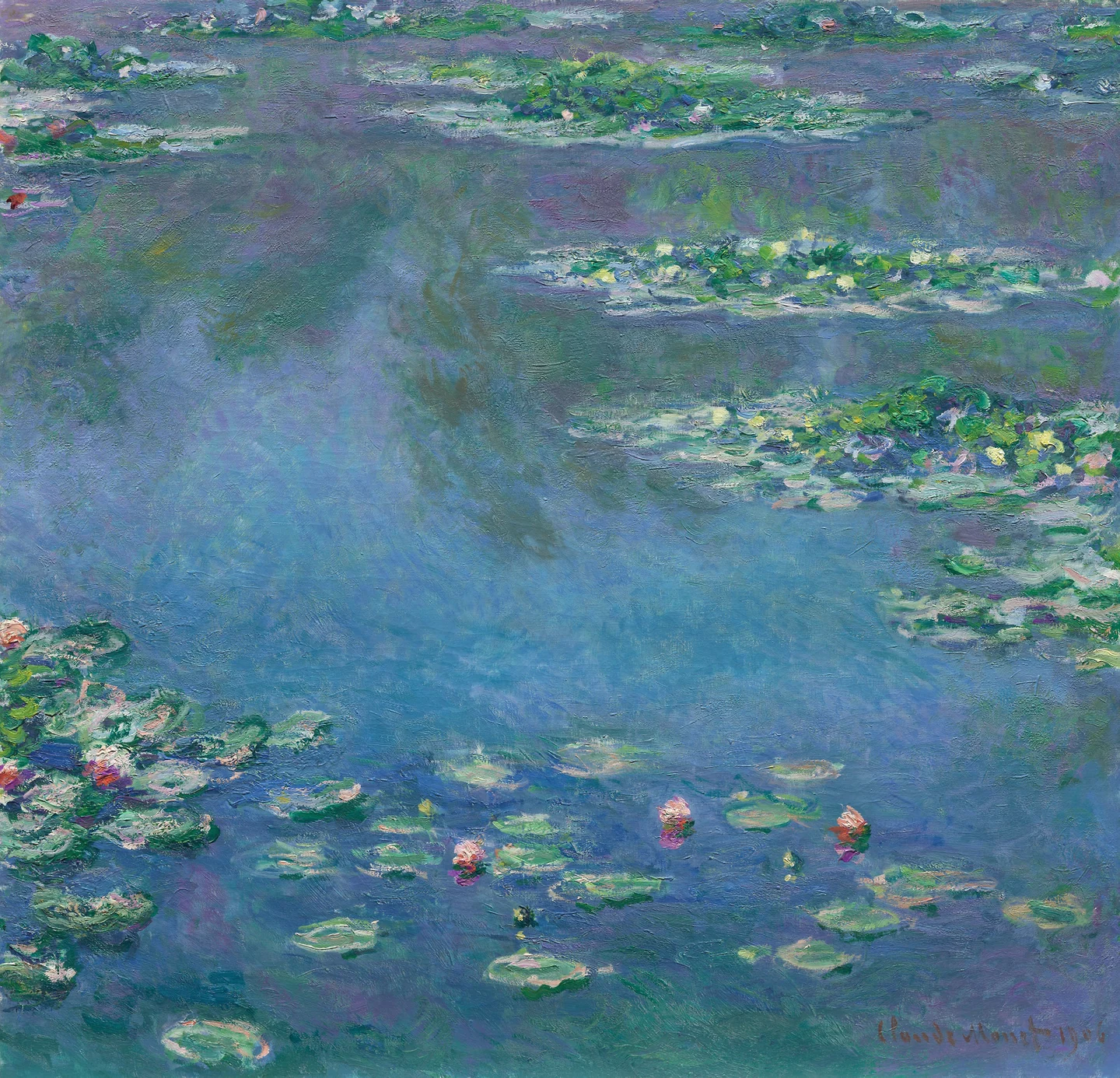
THE FULL STORY
How a Pond Without a Horizon Holds the Sky Beneath Our Feet
The pink and white flowers near the bottom may catch us first. They float securely, while the blue and violet around them gradually make looking less certain: is this water, or sky held in water? Search for a bank and no shoreline offers to explain the view. This Water Lilies of 1906 leaves us between floating plants and reflections. There is plenty to see, but the paths, bridges, and distant hills that usually help us read a landscape have stayed out of the picture.
In this story
- 01First, the Painter Created a Place to Look at Again and Again
- 02The Flowers Are Pauses, Not the Only Protagonists
- 03The Frame Leaves the Banks Outside
- 04A Light Surface, Made Through Many Stops and New Beginnings
- 05Why He Was in No Hurry to Exhibit the Paintings
- 06Across a Group of Paintings, Repetition Becomes Difference
- 07The Depth of Water Is Also the Surface of Paint
01First, the Painter Created a Place to Look at Again and Again
Monet did not happen upon this pond during a walk. In 1893 he bought land for his Giverny water garden, sought permission to divert water, and planted selected water lilies. He later enlarged the pond. Practical gardening lies behind this painted nature.
That gives the plants another dimension. Where flowers grow, how much open water remains, and where a tree reflection enters all belong to a cultivated place. Yet arranging a garden cannot arrange each day’s light. Plants keep growing and the water keeps reflecting its surroundings; a familiar location continues to offer different relationships. A painter can return to the same pond, but looking cannot simply arrive with the previous visit’s answers.
02The Flowers Are Pauses, Not the Only Protagonists
The pale flowers near the bottom are easy to recognize. Oval leaves spread beside them, giving each blossom somewhere to rest. Pink and white rise in brightness above the surrounding green, providing stopping places within the larger blue.
Between flowers, however, water occupies much more room. Plants crowd in from the left, another group reaches toward the center from the right, and a broad blue-violet opening remains between them. That unplanted space makes the leaves seem able to float, rather than lie flat on a patterned cloth. Small blossoms hold the eye; wider water gives it room to travel. The title names the lilies, but the painting makes them share our attention with reflections that are much harder to name.
03The Frame Leaves the Banks Outside
A tree can remain outside the picture while its reflection enters. Downward-reaching strokes of green and brown, their edges broken, offer a different direction from the horizontally spreading leaves. The leaves suggest a surface that supports things; the reflections make the same patch of color seem to open into depth.
No path leads us gradually into this space. Our gaze follows a vertical passage downward, then meets a leaf laid across it and returns to the surface. Beside that leaf, edges loosen and looking seems able to continue inward. Once the banks are cropped away, the outside world has not disappeared: it arrives by reflection. We move within a nearly square area, while distance keeps changing beneath our eyes.
04A Light Surface, Made Through Many Stops and New Beginnings
Technical examination found several painting sessions and covered-over lilies; one area contained nine paint layers. The water may look light, but its making involved a substantial buildup.
Covering a leaf does more than remove an object. Water color previously interrupted by the leaf can join up again, and the apparent distance between flower groups changes. The technique works in two directions at once: material accumulates while depicted things may disappear. Looking at the sparse flowers below, we feel that water has room around them. Such room can be made through revision. We cannot reconstruct the sequence of every stroke, but the examination shows that this openness was not simply preserved unchanged from a single first application.
05Why He Was in No Hurry to Exhibit the Paintings
Exhibition plans for the series were postponed. This canvas finally appeared in the 1909 Durand-Ruel exhibition in Paris. Its painted date and its public presentation as part of a group belong to different moments.
The painting offers a way to understand what repeated work might involve. More leaves would narrow the blue-violet opening; a stronger horizontal light might suddenly flatten a deep passage. Making water convincing requires more than a suitably watery color. What floats on top must remain in relation to what appears reflected within it. These are delicate connections, and changing one can affect another. We need not guess why Monet hesitated on a particular day: recognizing those dependencies already helps explain how an apparently expansive picture can contain so much work.
06Across a Group of Paintings, Repetition Becomes Difference
The Chicago canvas is about ninety centimeters high and ninety-four wide, almost square. It has its own boundaries and distribution of plants. Monet’s lilies may bring to mind an immense expanse of water surrounding us, but this particular painting gives looking plenty to do within a smaller area.
Plants gather near the upper edge, the middle opens, and scattered bright touches reappear below. Our gaze can move from flower to flower without following a single long route to its end. As it circles, a violet passage previously treated as background becomes noticeable; a green leaf’s edge begins to separate from the neighboring blue. Looking again has a practical consequence. The flowers remain where they were, but attention settles differently, changing the apparent weight of the water around them.
07The Depth of Water Is Also the Surface of Paint
Enlarge the image and ridges of paint appear around the leaves; the broader blue passages also retain the direction of the brush. Thicker touches on the plants catch light, while loosely overlapping water colors let contours open. Variations in thickness, width, and edges make one area seem to float above another that holds depth.
Recognizing this does not cost us the pond. We can see where a brushstroke stops and still feel that a flower rests on water. We can identify blue paint without losing the reflected sky. Our feet remain on the museum floor, yet looking seems to find a place beside the water. Monet has given us no bank to stand on. A few floating leaves are enough: they support the flowers, and this downward glance that takes us somewhere without requiring a journey.
References
- Musée des Impressionnismes Giverny: Monet’s Garden in Giverny
Land purchase, water diversion, planting, and enlargement of the water garden.
- Jill Shaw and contributors: Cat. 44 Water Lilies, 1906, Art Institute digital catalogue and technical report
Official indexed technical and exhibition passages consulted; direct catalogue access failed.
- Art Institute of Chicago: Water Lilies, 1906, collection record
1933.1157; version, date, and dimensions.
- Richard Kendall, selected Monet letters in English, museum-hosted document
Indexed passage of the letter dated January 28, 1909, consulted for postponement; no quotation. Direct file access failed.