Free to read · Ukiyo-e
Under the Wave off Kanagawa (The Great Wave), explained
A great wave bends into an arch about to fall. Three long boats lie between the swells, while Fuji remains small in the distance. In this celebrated design from Thirty-six Views of Mount Fuji, the mountain occupies little space, yet determines how we experience the scale of the nearby sea.
Read the full story ↓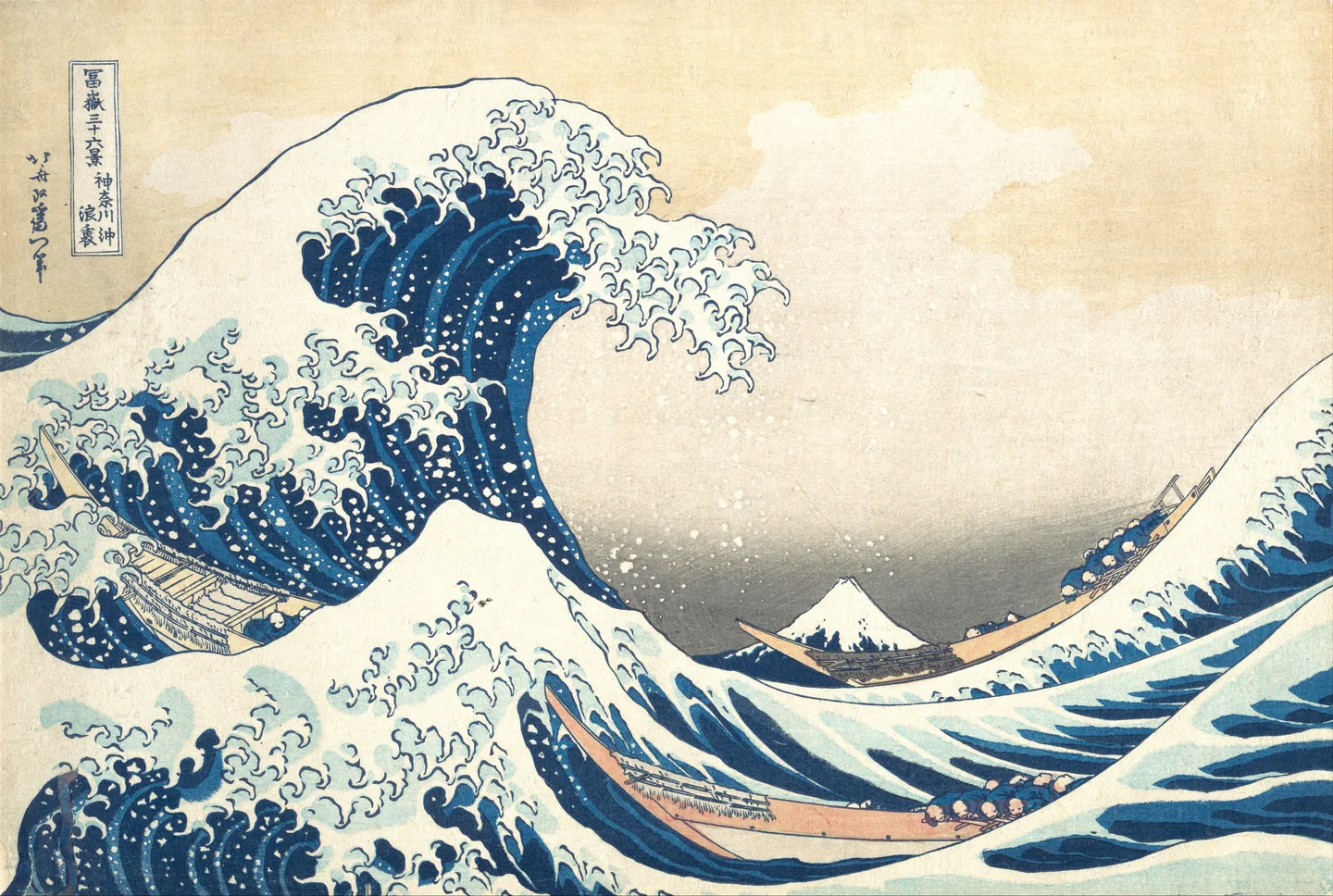
THE FULL STORY
At Seventy, He Was Still Finding New Waves to Draw
First, find the people in the boats. They crouch so low that their tiny heads almost disappear into the lines of the water. Above them, the wave's crest has already risen, its white foam spread like a hand about to close. You might feel your own shoulders hunch as you look. Remarkably, Hokusai was around seventy when he made this scene. And the real subject of the whole series was meant to be that tiny mountain in the distance.
In this story
- 01After so many years of drawing, he still hadn't seen enough
- 02These people still had fish to get to market
- 03Why are we tense before the wave has even fallen?
- 04How did Mount Fuji become smaller than the foam?
- 05The same wave looks a little different on every sheet
- 06The wave later found its way into music
01After so many years of drawing, he still hadn't seen enough
The Great Wave off Kanagawa belongs to Thirty-six Views of Mount Fuji and appeared around 1830–1832. Hokusai already had decades of experience making prints and illustrations. In his later years, he took another look at Mount Fuji from many different places.
Knowing something well doesn't necessarily make it boring. Sometimes the opposite happens: only after looking many times do you notice relationships you missed before. Here, he lets the wave rush into view first. Only when our gaze slips beneath it do we discover Fuji. The tall mountain we know suddenly becomes a small thing we have to search for.
02These people still had fish to get to market
The three long boats are fast craft used to transport fresh fish, linking the people aboard to coastal shipping and urban markets. Knowing this gives the scene the weight of everyday life: here is work we can understand, and the sea that comes with doing it.
Look again at those bent backs. The faces are too small to tell one person from another, but the movements are unmistakable. With a great wave bearing down, there's little room for a graceful pose. We don't know how this voyage ends, of course, but we can already sense how slight the boats and people are. From afar, the blue is wonderful to look at. From a place in one of those boats, it would feel immensely heavy.
03Why are we tense before the wave has even fallen?
Hokusai knew how to choose a moment. The foam reaches forward, the boats haven't yet disappeared, and the thing we fear most hasn't happened. Our eyes naturally move toward the next second: what happens when that enormous wall of water comes down?
Follow the wave's outer edge. It rises gradually, then suddenly breaks into many small white points at the crest. Below, the lines of the boats are long and thin, as if those curving shapes might trap them at any moment. The picture doesn't rely on great areas of darkness to suggest danger. The sky even leaves a broad expanse of pale color. Because we can see so clearly, that feeling of suspense is hard to shake.
04How did Mount Fuji become smaller than the foam?
Notice the pointed white wave nearby, then look at Mount Fuji's snowy summit in the distance. Their outlines are a little alike, one large and one small, echoing each other across the sea. Our eyes compare the two. Even knowing how tall the mountain is, we feel more threatened by the wave in front of us.
You can cover Fuji briefly with a finger. The great wave is still powerful, but we've lost a reference that helps us feel the distance. Uncover it, and the whole sea suddenly has depth again. The mountain occupies very little space, yet it does a great deal: it makes the wave larger and the boats smaller, and gives our gaze somewhere to rest for a moment.
05The same wave looks a little different on every sheet
This is a woodblock print, so many impressions of the image could be made. The one shown here is impression JP1847 in the Metropolitan Museum of Art's collection. Its sky has a warm tone, there is pale red along the sides of the boats, and the blue lines of the water alternate between darker and lighter shades.
We tend to think of a famous artwork as an image with one fixed appearance. Prints remind us that paper, printing, and preservation can all make a difference. That's part of the pleasure of looking closely at this particular image: the warm-colored hulls emerge from the blue, making the crews easier to find. Try looking at the sea alone, then bringing the boats into view. A spectacular arrangement of shapes becomes a situation that people are living through.
06The wave later found its way into music
In 1905, a detail from this wave image appeared on the cover of the first edition of the score of Debussy's La Mer. Moving from a Japanese print to a French musical score, the wave found another way to be seen. The water on paper is silent, yet it could suggest the sea's power to another art form.
By now, thinking again of the tiny people in the boats gives the wave's beauty an added weight. Its beautiful shape may draw us in first, but what keeps us looking is the life beneath it. Hokusai gave danger a shape and left the people a little space that has not yet been swallowed. The picture always stops before the wave falls, so we can still wait with them for the next moment.
References
- The Metropolitan Museum of Art: The Great Wave off Kanagawa, JP1847
The date, medium, and collection record for the impression used in this app. Descriptions of color and composition are based on the existing image.
- Asian Art Museum, San Francisco: Artist Profile of Katsushika Hokusai
Thirty-six Views of Mount Fuji in his later years, and his many preceding years of work on prints and illustrations.
- British Museum Collection Record: 1937,0710,0.147
Timothy Clark's 2001 commentary on the oshiokuri boats used to transport fresh fish. The information can be checked in the museum's search results; direct access to the page was unsuccessful, so no link is provided.
- Michael Cirigliano II: Hokusai and Debussy’s Evocations of the Sea, The Met, 2014
The visual connection on the cover of the first edition of La Mer in 1905. The main text does not interpret any particular melody as a specific pattern in the waves.