Free to read · neo-impressionism
A Sunday on La Grande Jatte — 1884, explained
After years of preparation, Seurat arranged the people at leisure on the banks of the Seine into a quiet modern ritual. In his painting, an ordinary Sunday afternoon takes on the order and dignity of a classical relief.
Read the full story ↓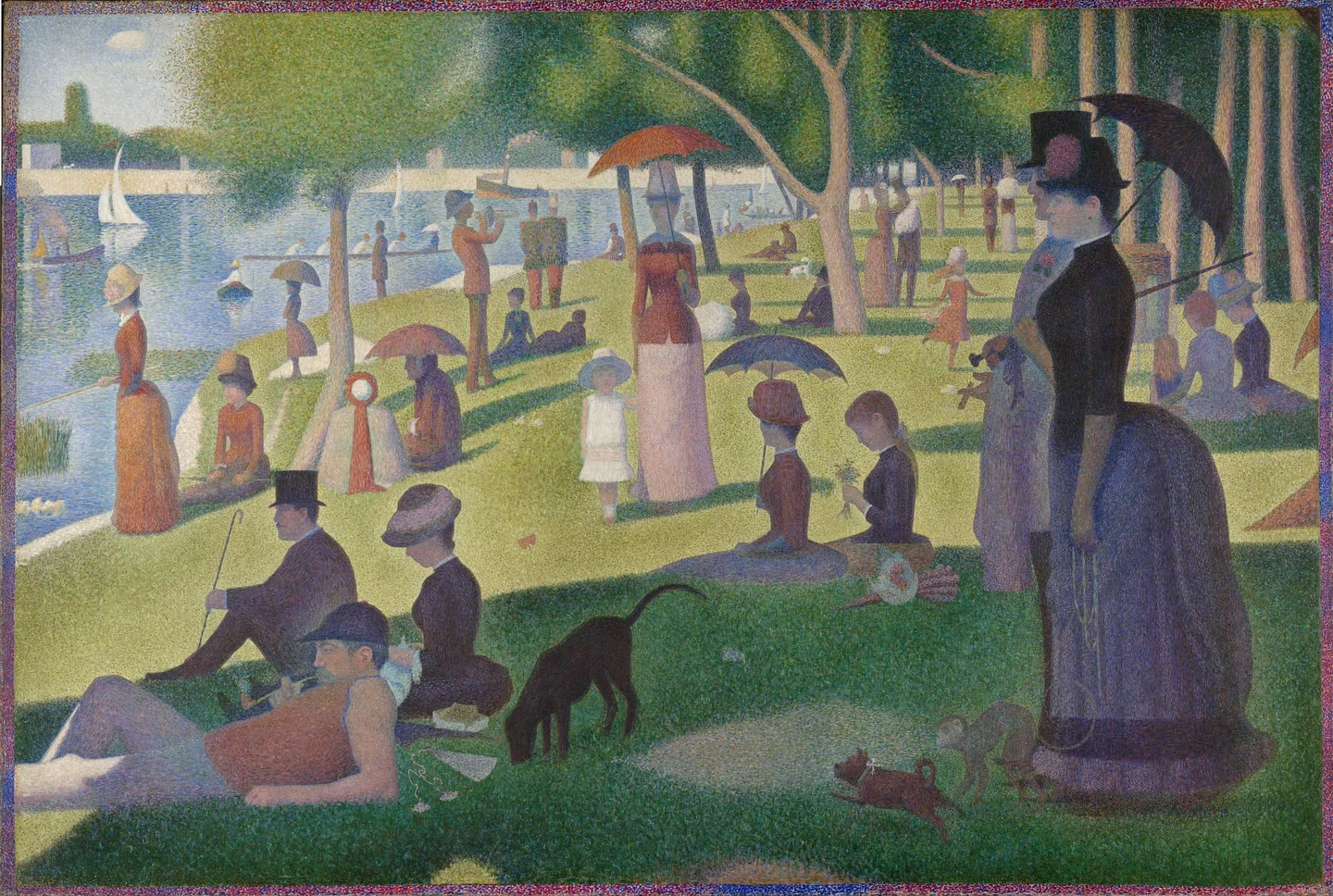
THE FULL STORY
A Sunday Afternoon Arranged as a Gathering That Never Quite Disperses
A weekend by the river ought to be a chance to loosen up. Yet the people on Seurat’s lawn look dressed and ready for a group photograph. On the right, a woman’s skirt swells into an elegant curve beside a man’s upright top hat. Lower down, a small dog stretches forward and a monkey curls its tail. The animals seem more at ease than the people. Move closer, though, and somebody else takes over the activity: the surfaces of those quiet bodies are busy with tiny touches of color.
In this story
- 01The Young Seurat Wanted More Than Another Outing
- 02The World on the Island Has Been Selected
- 03Everyone Occupies a Clearly Defined Place
- 04The Little Monkey Puts a Sudden Twist in Respectable Outlines
- 05Particles of Color Keep the Eye at Work
- 06In 1886, a Scene of Leisure Provoked Controversy
- 07Beyond the Lawn, Color Keeps Working
- 08Behind the Familiar Image, the Discussion Continues
01The Young Seurat Wanted More Than Another Outing
Seurat worked on the large canvas from 1884 to 1886. Related drawings, paintings on small panels, and larger studies show that the company did not settle into place in a single afternoon. Individual parts had to find their place within a whole.
This lawn, roughly three meters wide, resembles a long bench reluctant to give up any space casually. The large figures on the right occupy the edge; the reclining man at the lower left brings the weight down low. Between them, smaller visitors can emerge into view. So many people avoid becoming a jumble because those broad shapes establish an order first. We recognize a leisurely afternoon while sensing that its leisure has been arranged with considerable care.
02The World on the Island Has Been Selected
La Grande Jatte, an island in the Seine, had places to eat and dance as well as boatbuilding yards. Seurat chose a patch of parkland. Other kinds of life continued beyond the frame.
That selection gives the lawn an almost independent order. Bright water opens on the left, deep shade pushes in from below, and a sunlit strip of grass runs between them. People occupy different degrees of light, as though each has found a suitable place for the day. Their clothes remain considered and their hats properly worn; going into nature has not entirely loosened everyday habits. The scene feels quiet partly because of the trees and water we can see, and partly because so much that could disturb it has been left out.
03Everyone Occupies a Clearly Defined Place
The little girl in pale clothing faces us near the center, easy to recognize among profiles and backs. Behind her, a taller woman stands straight, her parasol opening sideways as though to provide a roof for this small patch of brightness.
Changes in scale tell us about distance, while repeating contours connect separate places. Tree trunks echo upright bodies; parasols and skirts offer one curve after another. A reclining figure or an extended walking stick interrupts the vertical rhythm. Composition here means more than placing a principal character in the middle. Different directions seem to take turns. Our gaze can travel from foreground to distance, then move sideways between related shapes. The lawn has depth while also resembling an intricately woven, continuous surface.
04The Little Monkey Puts a Sudden Twist in Respectable Outlines
The monkey crouches near the large skirt on the right, its tail making a conspicuous curl. Follow the woman’s upright body downward and that little bend suddenly takes the eye elsewhere. A small dog stretches forward; a dark dog lowers its head. They interrupt the gathering’s orderly rhythm with movements that seem much less concerned with appearances.
The monkey alone cannot settle the woman’s social identity; the museum’s research leaves the figures’ status and motives open to debate. What we can enjoy directly is how closely order and unruliness coexist. The long skirt gathers a body into one clean outline, and a tail loops beneath it. Human dignity remains intact, yet the gathering has become a little harder to regard with complete solemnity.
05Particles of Color Keep the Eye at Work
Up close, the lawn is no longer an evenly spread green. Dots, short dashes, and broader underlying marks sit together, with warmer and cooler colors alternating. Pointillism describes the small marks; divided color concerns what happens when separately applied colors are seen together. Drawing on contemporary color theories, Seurat hoped their optical combination would produce greater brilliance.
That does not mean every dot must disappear before we are seeing the picture correctly. We may notice the particles and recognize grass and clothes at the same time. Contours keep the bodies steady, while alternating colors prevent their surfaces from becoming inert. A warm touch beside green briefly redirects attention; many such tiny shifts create a delicate tremor across an afternoon in which the people scarcely move.
06In 1886, a Scene of Leisure Provoked Controversy
The painting debuted at the eighth and final Impressionist exhibition in 1886, becoming a landmark of Neo-Impressionism. Here were modern people enjoying an outing, but the painting seemed to run at a different speed: the figures paused while color remained active.
That helps explain why the scene can feel stiff without becoming easy to leave. Leisure usually leads us to expect relaxed poses and incidental gestures. Here, a hat, a skirt edge, even a gap between two people seems to carry weight. Following only the dots misses the bodies’ stability; treating the company as a rigid procession misses the constant small changes across its surface. Both rhythms are needed for this Sunday gathering, which never quite resembles an afternoon caught on the spur of the moment.
07Beyond the Lawn, Color Keeps Working
The narrow colored border is paint too, added by Seurat in 1888–89. It encloses the riverside scene without bringing its rhythm of small marks to a stop. At the edge, the eye still encounters colors placed beside one another, as though the landscape were acknowledging that it is a painting.
Nor are today’s colors exactly their original selves. Research identified the darkening of zinc yellow, which also altered the effects of colors combined with it. A brownish passage need not represent the artist’s original preference for a subdued tone. The border was a deliberate later addition; the pigment change occurred over time. These small clues restore a before and after to an afternoon that seems so firmly suspended.
08Behind the Familiar Image, the Discussion Continues
In 2004, a Chicago exhibition brought many related studies back into the company of the large painting. Separately worked trees and figures made the familiar lawn disclose something of its making.
Knowing it could be assembled in stages changes the gaps between its people. Empty space is not merely a place where nobody stands: it lets a skirt keep its contour, makes the little girl visible, and allows two nearby figures to seem separately occupied. Are strangers sharing a Sunday, or are companions simply quiet for a while? We need not settle that question to recognize the situation. People have come to the same place to rest, each still carrying a life of their own. The river is bright, and the gathering shows no sign of breaking up.
References
- Art Institute of Chicago: A Sunday on La Grande Jatte, collection record
1926.224; dates, dimensions, and the later painted border.
- Art Institute of Chicago: 2004 exhibition overview
Related drawings, panel paintings, and larger studies.
- Art Institute of Chicago: Seurat and the Making of La Grande Jatte—Exhibition Themes
The island setting and unresolved interpretations of social identities.
- James Voorhies, Post-Impressionism, The Metropolitan Museum of Art
English text; color theory and the 1886 debut.
- Art Institute of Chicago: Microscopy at the Art Institute of Chicago
Darkening of zinc yellow and its effects on combined colors.