Free to read · Realism
Luncheon on the Grass, explained
Édouard Manet painted Luncheon on the Grass in 1863 in oil on canvas. It is recorded here through the Musée d’Orsay’s collection information. The work brings together the nude and landscape traditions and can be considered alongside the experiments of Realism. Manet’s direct brushwork and modern figures challenged academic conventions, making him an important link between the Old Masters and modern painting.
Read the full story ↓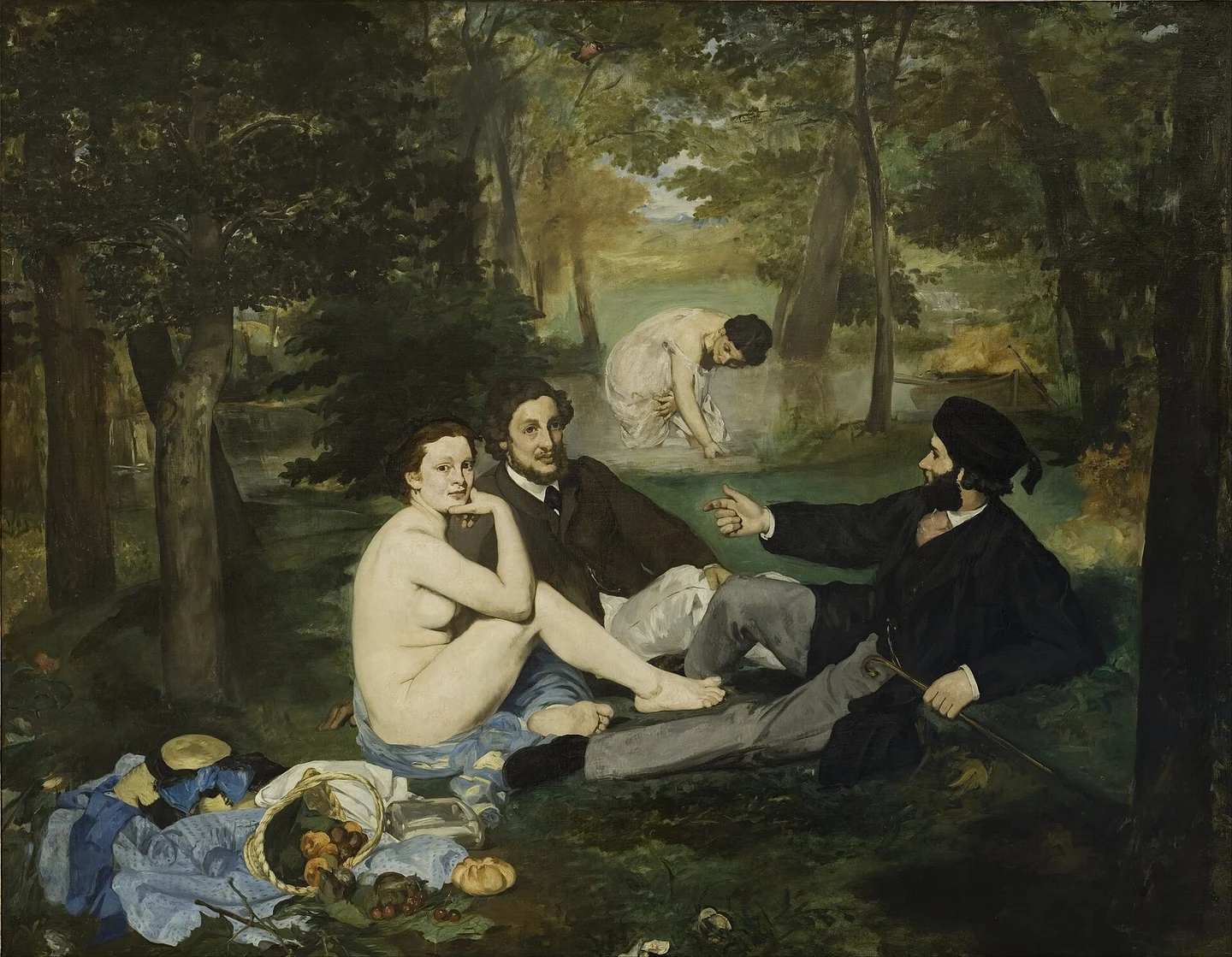
THE FULL STORY
She Sees Someone Beyond the Frame, and Lunch Is No Longer Ordinary
The bread is out, fruit has spilled beside the basket, and clothes cover the ground. This outing has plenty to eat, but it is hard to know where to sit. Between two men in jackets, a nude woman looks straight at us. The man on the right extends a hand as though still making a point; she brings somebody outside the picture into the gathering. Manet never supplies their conversation. The way these people sit together is enough to make lunch an awkward occasion.
In this story
- 01A Thirty-One-Year-Old Painter Enters the Salon des Refusés
- 02An Old Composition in Contemporary Clothes
- 03Her Gaze Opens the Conversation to Us
- 04Why Does the Distant Bather Seem Too Close?
- 05The Light Does Not Gently Fade into Shadow
- 06Still Life Leaves Clues to Unexplained Relationships
- 07Picasso Takes the Picnic into Another Outdoor Space
01A Thirty-One-Year-Old Painter Enters the Salon des Refusés
Rejected by the Paris Salon in 1863, the thirty-one-year-old Manet exhibited this canvas as The Bath at the Salon des Refusés, where it provoked ridicule and controversy. Now at the Musée d’Orsay, the original is over two meters high and two and a half meters wide.
At that size, these people cannot easily be dismissed as an inconspicuous picnic party. Jackets, hats, and trousers bring the occasion close to everyday life, yet beside them sits a woman with no clothing to cover her body. A distant myth cannot conveniently smooth over the discrepancy. The larger the painting, the more immediate the encounter: are we appreciating a familiar kind of nude, or have we walked into a gathering we do not quite know how to face?
02An Old Composition in Contemporary Clothes
This apparently unruly arrangement has old connections: Titian’s Pastoral Concert and the figures at the lower right of Marcantonio Raimondi’s engraving of The Judgment of Paris, after Raphael, lie behind it.
Once we know this, the bent arms, extended legs, and overlapping bodies no longer look merely like positions people happened to find on an outing. They hold a group together: one form rises where another drops; bodies overlap while faces remain available to view. Yet the inherited arrangement does nothing to settle the awkwardness of this new occasion. The poses seem familiar; the relationships do not. An old seating plan has acquired a different cast, and knowing where the poses came from still leaves us wondering what these people are doing together.
03Her Gaze Opens the Conversation to Us
The foreground woman is associated with the model Victorine Meurent. Her hand supports her chin, her shoulder turns toward us, and her back slopes away on another course. This twist makes her face more than the uppermost part of a body: it becomes an opening toward somebody beyond the frame.
The man’s extended hand directs attention toward his companions; her eyes send it back to us. Within one small circle, looking takes two different routes. We may find her gaze composed, or we may find it uncomfortable. Those are our responses to the encounter, not a record of her feelings. The painting never tells us whose answer she might be waiting for. That unanswered look is difficult to finish with.
04Why Does the Distant Bather Seem Too Close?
Through the gap behind the group, another woman bends beside the water. Her position ought to put her some distance away, yet her body remains conspicuously large and her pale clothing catches the eye directly. The woodland suggests a route into depth; her figure seems to pull some of that distance forward again.
A painter can connect near and far by gradually reducing size, softening contours, and weakening contrasts. Here, those different signals do not quite agree. We recognize trees, water, and people, but assembling them into ground we could actually walk across is harder. The eye believes in the objects while noticing their arrangement. It is a little like listening to a story in which two events, normally far apart, have suddenly been placed side by side.
05The Light Does Not Gently Fade into Shadow
Manet’s abrupt contrasts, with less of the customary gradual shading, also provoked criticism. Look at the woman’s shoulder and back: a broad pale area meets the dark clothing behind it, establishing the contour immediately. Beneath her arm, shadow makes the bend sharply legible.
This does not mean that the body has no volume. The turning knee, angled elbow, and overlapping legs still describe its position, but that volume is not built by smoothing every transition. Differences in lightness between adjacent shapes bring the figure forward; smaller turns complete the body. The foliage around her is handled much more loosely. Skin, clothes, and woodland seem to speak at different speeds, resisting an easy merger into one comfortable atmosphere.
06Still Life Leaves Clues to Unexplained Relationships
The relationships are hard to read; the bread at the lower left is reassuringly tangible. Its rounded shape and scored surface suggest how it might feel to break a piece off. The basket tips toward us, fruit meets blue fabric, and food, clothes, and grass share one crowded patch. No table separates their territories.
This little still life also helps organize the picture. Blue cloth spreads from the lower edge toward the seated woman, while the warm fruit provides small, noticeable accents beside cooler colors. The eye can rest here, then follow the fabric back to her body. Her direct gaze is not the painting’s only entrance: a loaf and a basket can bring us into the scene as well. Their everyday familiarity makes the unexplained company around them seem stranger.
07Picasso Takes the Picnic into Another Outdoor Space
Almost a century later, Picasso was still taking this group apart. He made movable cardboard models in 1962; an outdoor sculpture made from his models by Carl Nesjar eventually stood in the grounds of Moderna Museet in Stockholm. Viewers could now walk around the figures.
This gives the seating arrangement another kind of continuation. On a flat surface, front and back stay fixed; in actual space, they change as we move. Two people who seem close from one direction may reveal a gap from another. Manet’s painted relationships have something of that invitation to keep shifting position. Everything for lunch is laid out, but the story still lacks a chair that would settle everybody comfortably. The woman continues to look toward our side of the gathering.
References
- Musée d’Orsay: Le Déjeuner sur l’herbe, collection record
RF 1668, the 1863 original; exhibition history, dimensions, and tonal handling.
- Musée d’Orsay: Picasso / Manet, Le déjeuner sur l’herbe
Historical references, model identification, and cardboard models; no artist quotations.
- The Metropolitan Museum of Art: Raimondi, The Judgment of Paris
Engraving 19.74.1; attribution and the lower-right figure group.
- Moderna Museet: Déjeuner sur l’herbe, outdoor collection
Nesjar’s sculpture made from Picasso’s cardboard models.