Free to read · Dutch Golden Age Painting
Girl with a Pearl Earring, explained
This painting belongs to the Dutch tradition of the tronie, a head study focused on expression, costume, and light rather than a sitter’s social identity. The girl turns toward us with slightly parted lips, as if responding to a greeting. Her actual identity remains uncertain.
Read the full story ↓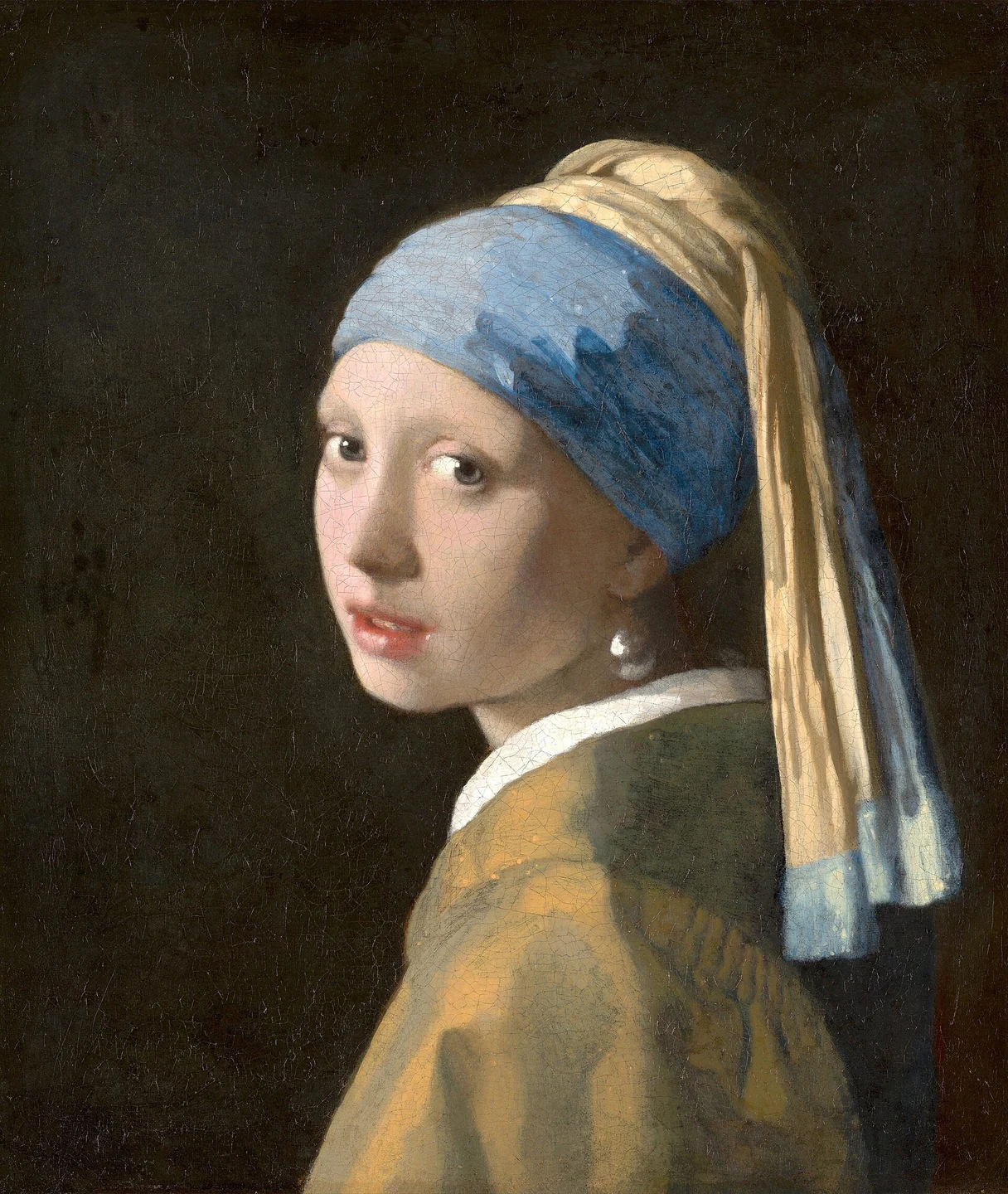
THE FULL STORY
She Turns, and Light Does Half the Talking
You've probably known a moment like this: someone is about to leave, then suddenly turns back, lips slightly parted. Instinctively, you wait, feeling she still has something to say. Vermeer held on to that instant. Centuries have passed, and she still hasn't spoken. Girl with a Pearl Earring makes it so easy for viewers to feel her gaze, yet offers almost no clues to her everyday identity: no room, family, or letter on a table to explain who she is. More and more people grow curious. Stranger still, the “pearl” that makes her so memorable turns out, when you look closely, to be less fully painted than you might expect.
In this story
01Don't give her a love story just yet
Who is she? We still have no definite answer. When Vermeer painted her around 1665, he was in his thirties. He used a type of head study known in Dutch painting at the time as a “tronie,” which focused on appearance, costume, and expression without necessarily identifying the person by name.
Her blue and yellow headscarf and striking earring make her look specially dressed for the occasion. Yet the way she looks at us feels so natural that it's hardly surprising people want to give her a family, a love story, even an entire life. Those stories can be moving, but back in front of the painting, let's leave this small mystery open: who she was and why she makes us stop are two questions we can explore separately.
02An expensive-looking pearl, made with just a few strokes
The bright patch below her ear is the painting's most eye-catching detail. Look a little closer: it has no neatly drawn outline, and there's no visible silver hook attaching it to her ear. A highlight at the top and a reflection from the collar below are enough for a few strokes of color to suggest a smooth, rounded pearl.
Step back, and it looks whole again. That shift is worth enjoying: the artist has actually painted less than you think you see. Your eyes fill in the rest. The light on the earring echoes the highlight on her lips, and your gaze can easily linger first on one, then the other. Whether the earring was an imitation pearl or something the artist imagined remains a subject of discussion. But the light created by those few strokes of paint is already convincing.
03Her shoulders make us pause, too
Try covering the lower half of the painting with your hand and looking only at her face. She's still lovely, but somehow seems less alive than before. Reveal her shoulders again, and you'll see why: her body faces one way while her face turns back. The sense of movement comes from the difference between those two directions.
The hanging end of her headscarf draws our gaze backward, while the light on her neck brings it back toward her face. Her lips are only slightly parted, and her teeth aren't carefully painted in a row. It's as if a sentence is still at its beginning. Of course, we can't hear it. But remembering a time when we called out to someone like this can make the distance in the painting feel smaller. She hasn't come any closer, yet we're already responding to her.
04There was a curtain hidden in the dark
The background we see today is almost black. It's easy to feel that the girl simply emerges from nothing. Research, however, has found traces of a green curtain. As the pigments changed, the curtain's folds and color gradually faded from view, leaving the darkness we see now.
Knowing this gives the space around her a surprising quality: time has helped shape the painting we see today. The once-visible fabric has receded, making the figure stand out more strongly. Scientific examination hasn't revealed her life story, but it has shown that this familiar image hasn't remained unchanged for centuries. The green behind her was once part of this turn of the head, too.
05That natural turn took time and adjustment
Research also found that Vermeer adjusted the positions of the ear, the upper edge of the headscarf, and the back of the neck. The most natural-looking passages may have taken the most thought. Changes to the ear, the outline of the headscarf, and the back of the neck all affect how the head turns back over the shoulder. Small as they are, these changes influence the whole pose: an ear placed too far forward makes the face seem squeezed narrower, while a slight shift in the back edge of the neck changes how far the head appears to turn. Now the curved surface of the blue headscarf meets the shadow on the neck with a light touch, while the collar supports the face from below.
It makes you want to look again at that soft curve of her neck. We see a single instant, but the artist worked through one small decision after another. Sometimes an effortless appearance means the effort has been very well hidden. The next time you try several times to turn naturally for a photograph, you may have a better sense of the difficulty here.
06She hasn't always been in the spotlight
In 1881, the painting was auctioned in The Hague. The collector des Tombe bought it for two guilders plus a commission of thirty cents. He died in 1902 and bequeathed the painting to the Mauritshuis. This face, so familiar today, once changed hands for very little.
The contrast in value is startling. But back in front of the painting, what holds us is still that slight sense of a response. The background doesn't tell us where to go, and her headscarf doesn't tell us what she's about to do. Only her gaze, her lips, and the light beside her ear keep us there. She doesn't have to tell her whole life story. A single turn of the head is enough to make a stranger willing to wait.
References
- Mauritshuis: Artwork Record and Collection Catalogue Commentary
The type of painting, the handling of the pearl, the 1881 auction, and the bequest. The museum's text was adapted from its 2005 collection catalogue; this account uses that information in an original narrative.
- Mauritshuis Research: Closer to Vermeer and the Girl
The green curtain and adjustments to the positions of the ear, headscarf, and back of the neck. The remaining passages on looking at the painting are original observations.