Free to read · Renaissance, High Renaissance
The Last Supper, explained
Leonardo da Vinci created this wall painting for the dining room of the Santa Maria delle Grazie convent in Milan around 1495-1498. The scene chooses the moment when Jesus announces that someone will betray Him, and the reactions of the twelve disciples spread like ripples to both sides. It remains in its original location, and the work's fragile state is also related to the painter's experimentation with materials and subsequent environmental changes.
Read the full story ↓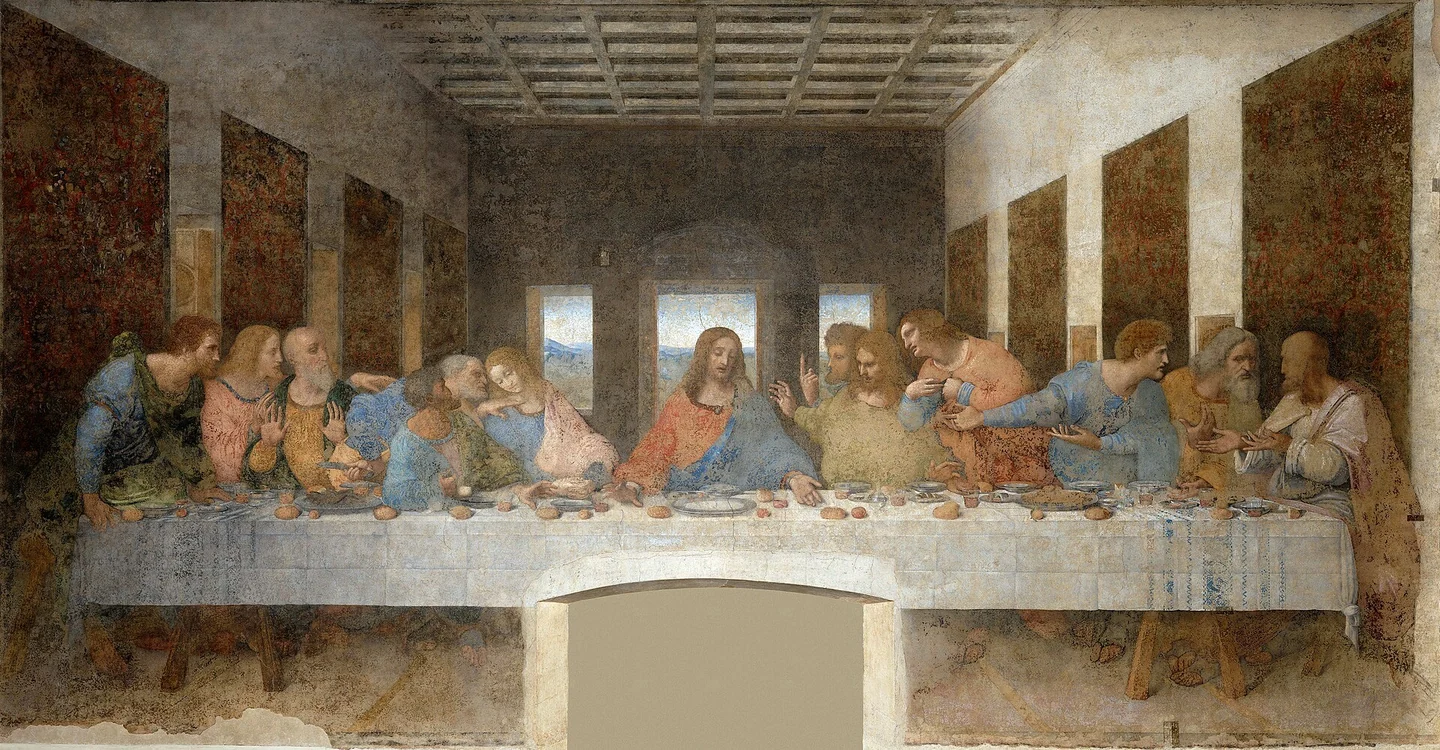
THE FULL STORY
A Supper Held at the Moment Trust Shatters
The meal isn't over when Jesus suddenly tells the disciples around him: one of you will betray me. Imagine sitting at that table. Would every familiar face suddenly seem strange? Leonardo holds the scene at the moment the news begins to spread. No one has left their seat, but hands are already moving and shoulders turning. You can almost feel that no one at this table can simply carry on eating.
In this story
01Seemingly chaotic, but clearly grouped
The work is dated to 1495–1498. Leonardo was then working within the court culture of Milan, where the Sforza family's patronage supported his connections between architecture, music, engineering, and painting. He wasn't simply pursuing a beautiful image in his studio. At the time, he was interested in light, sound, movement, and how emotions appear in people's gestures and faces. This doesn't let us invent his day-to-day moods, but it does reveal a clear artistic question: how can an invisible inner life be understood through a visible body? The varied reactions in the painting unfold that question across the wall.
Jesus sits at the center, with the twelve disciples subtly divided into four groups of three, each forming a triangle. Glances and movements of the arms connect the groups and direct all their energy back toward Jesus: movement without confusion, order with variety. Looking to the left of Jesus in the picture, you'll find a man drawing back and holding a money bag in the second group of figures. That is Judas. Everyone else's face is in the light, while Judas alone draws back, his face held in shadow, suggesting inner darkness and betrayal.
Earlier painters always placed Judas alone on the opposite side of the table; Leonardo was the first to place him among the disciples. The betrayer hasn't been put in a distant corner for us to identify. He's among people he knows, sharing their meal. That arrangement gives the story a sudden sting: before the betrayal, the betrayer, too, was one of the people at the table. Look again at his retreating body. The more urgently those around him lean in and ask questions, the more noticeable that small withdrawal becomes.
02Why is the center so calm?
All around him, gestures reach outward, while Jesus remains relatively still. His arms extend to either side, and his body forms a steady shape at the center. Your gaze travels in from the left, gets drawn away by gestures on the right, and eventually returns here.
It's rather like the person who suddenly falls silent during an argument. The more agitated everyone else becomes, the more you wonder why he stays still. The tension isn't shared equally among the thirteen faces: some areas are crowded, while others leave space; some hands seek answers, while others have come to rest. No single gesture is especially startling on its own. Put them together, and the relationships emerge.
You may know the experience: someone says everything is fine, but their shoulders have already tensed. We often understand the body before we understand the words. Leonardo brought this ability into religious painting. Each figure has his own reaction, and familiar gestures give viewers a way into a distant story. The names can wait. To begin with, it's enough to follow their bodies and feel the moment.
03This meal was painted in a dining room
The painting remains in the former refectory of the convent of Santa Maria delle Grazie in Milan. The friars who once ate here could look up and find themselves facing another long table. In the painting, the ceiling and side walls converge into the distance, making it seem as though another room extends beyond the real wall.
Imagine looking from that position: you're sitting down to eat, and so are the people in the painting. Bread, a tablecloth, cups, and plates are all familiar things, yet an enormous upheaval takes place in the midst of this ordinary setting. The picture brings viewer and story so close that the words seem able to cross the wall and enter the real dining room.
04He wanted time to paint; the wall couldn't hold the color
Leonardo worked on a dry ground, which allowed him to make repeated adjustments. But this experiment also left the paint layer especially fragile, and the work began to deteriorate soon after it was finished. Later, some people tried to paint back over the missing areas, while others tried to secure the remaining paint. Some early interventions caused further damage. Modern restoration gradually removed the later overpainting, working to preserve as much of the original as possible.
So when you see today's patchy surface, take a little time to look. The colors cannot be returned to the complete appearance they had when freshly painted, but we can still make out the direction of a hand and the distance between bodies. The painter spent a long time preserving a fleeting scene. Those who came afterward spent even longer trying to preserve his work.
05The story pauses before anyone leaves
Vasari was already full of praise for the work in the sixteenth century, and it was repeatedly copied and studied afterward. Yet all these years later, we can still enter it through a very simple feeling: once certain words are spoken, relationships can never quite return to what they were.
The change in the story is enormous, yet the table still looks as it did during the meal. The plates are there, the tablecloth is still neatly laid, and even the distant view through the windows seems peaceful. Something has happened, but it hasn't yet had time to alter the things around it. Leonardo preserved that interval. That's where the quiet pull that keeps us looking lies.
References
- The Last Supper Museum: Artwork Record
The circumstances of the painting's creation, its original location, and Vasari's assessment as quoted by the museum.
- Museum Feature: A powerful theatrical machine
Identification of the figures, their poses, and the refectory space. The everyday comparisons in the main text are original interpretations.
- Museum Conservation Research: Backstage
The dry-wall painting technique, early deterioration, and conservation history.