Free to read · Mythological and Allegorical Painting
Primavera, explained
Sandro Botticelli’s Primavera, painted about 1480, is included here on the basis of the Uffizi Galleries’ records. Its medium is oil-enriched tempera on wood, known as tempera grassa. The work belongs to mythological and allegorical painting. With flowing contours, rhythmically arranged figures, and allegorical narratives, Botticelli shaped one of the early Renaissance’s most recognizable visual languages.
Read the full story ↓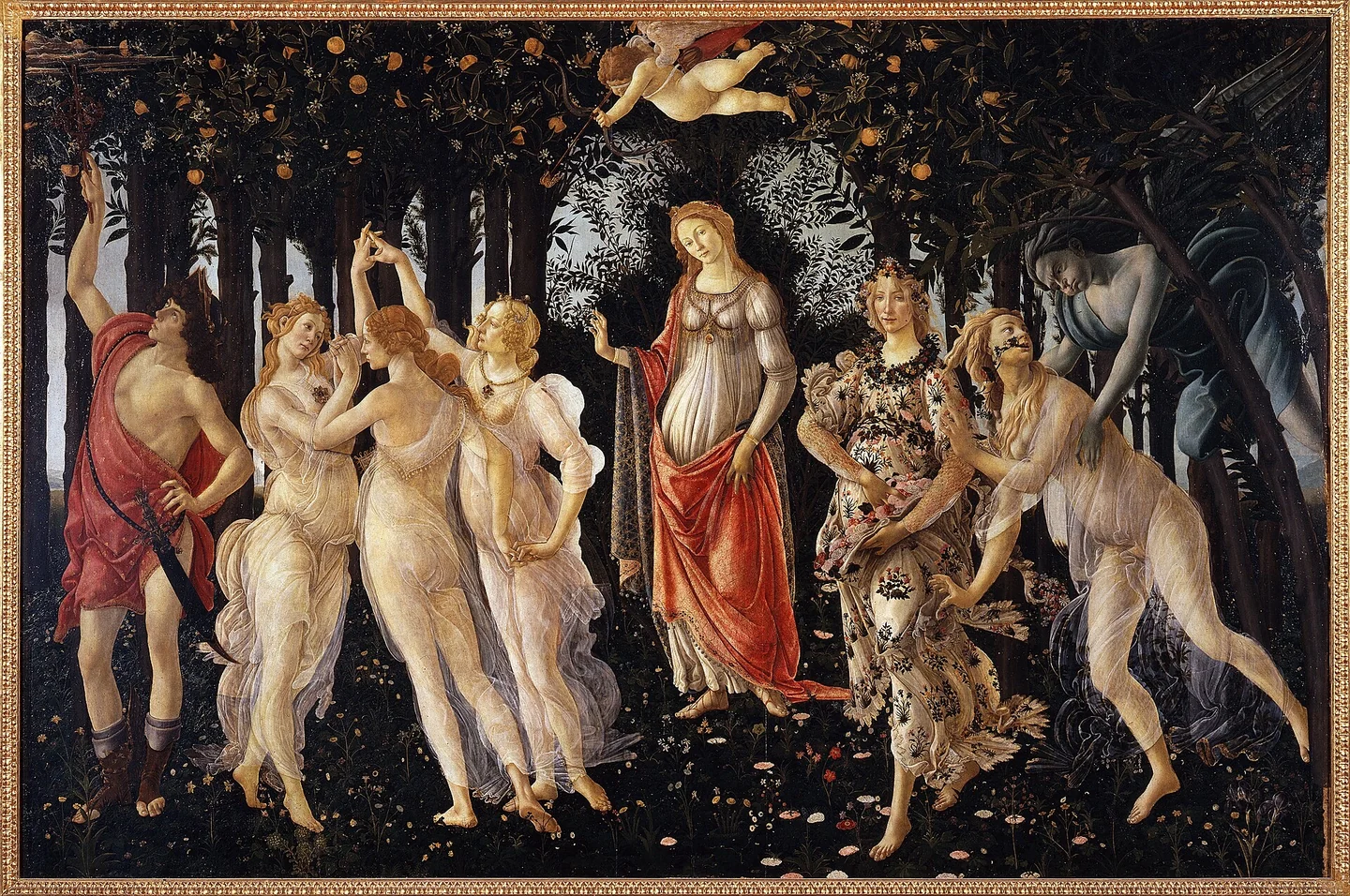
THE FULL STORY
Wind, Desire, and Order in the Garden
Spring in this garden does not begin with a bright sky. Trees grow thickly, orange fruit hangs in the shadows, and flowers almost cover the ground. Yet nine mythological figures move in different directions. On the right, one pursues, another struggles free, and another scatters flowers from a fold of her dress. On the left, some dance while another looks up and stirs the clouds. At the center, Venus gently raises her hand, as though welcoming a visitor or setting a beat for all this restless change.
In this story
01A Great Garden in a Private Room
The Uffizi dates Primavera to about 1480 and lists its medium as tempera grassa, an oil-enriched tempera, on wood. More than three meters wide, it is far larger than a small decorative picture held in the hands. In the late fifteenth century it stood above a chest-like seat with a back in the Florentine home of a branch of the Medici family, moving later to the Villa di Castello. This mythological garden once bordered a room in everyday use, giving the figures’ scale a tangible point of reference.
Try finding a path through the grass. The painting offers little invitation to travel into the distance. Most figures occupy a shallow strip of ground, with tree trunks rising behind them and flowers fine enough to make us want to bend down. The space feels close yet keeps us outside, like a curtain with depth: the garden enters the room, but its story stays before us. The principal encounters unfold sideways, between the figures.
02One Woman Appears Twice
At the right, blue-gray Zephyrus bursts among the trees with puffed cheeks and reaches toward Chloris. She turns her head while leaning the other way, and flowering stems emerge from her lips. Beside her, Flora advances calmly in a flower-covered dress. This is one life before and after a mythological transformation: Chloris becomes Flora, goddess of flowers. Botticelli places successive events side by side, joining the disturbance of one body to the composure of another.
The women’s shoulders are close, but their poses do not form one continuous movement. Chloris looks upward and back, spreading her fingers as thin fabric trails behind her to the right. Flora approaches almost frontally, gathering her dress in one hand and holding flowers in the other. The stems escaping from the mouth, followed by flowers covering the fabric, make the transformation legible. A small bodily detail expands into an entire figure’s appearance.
This springtime story also contains unease. The pursuer presses down from above while the pursued body strains away. Their power is unequal. Botticelli has not made the scene on the right as easy as the Graces’ dance. The abundance of flowering and the urgency of intrusion remain visible together; celebrating spring need not erase their difference.
03Sheer Drapery Suspends the Dance in Air
The Three Graces, symbolizing beauty, joy, and youth, stand close without merging into a mass. Their raised hands connect, while elbows, wrists, and fingertips enclose spaces of varying sizes. Thin fabric slides over their bodies, gathering into fine lines at legs, shoulders, and arms. Their turns are not identical: one shows her back while the other two face into the circle at different angles. The dance both displays bodies outwardly and preserves its own intimacy.
The transparent fabric rewards slow looking. Where it clings to skin, flesh color still shows through; at folds, overlaps, and edges, fine whitish lines become distinct. Changes in the placement and density of one color make cloth visible without hiding the body. Shoulders, waists, and knees remain legible, while folds follow a separate curve, as though the movement has already happened and the fabric is still catching up.
Look again at their joined hands and the dark background showing between their arms. Those gaps belong to the composition too. Spaces enclosed by bodies widen and narrow, allowing the eye to stretch out, then drawing it in. The rhythm of the dance lies partly in places where no figure has been painted.
04Why Is the Center Uncrowded?
Venus stands slightly farther back. The foliage provides a clearly shaped background around her head and upper body, while a red mantle falls beside her, making the center noticeable without making it loud. Compare the position of her toes with those of her neighbors and this small retreat becomes apparent. It gives the middle of the painting room to breathe.
Above, blindfolded Cupid draws his bow toward the left. At the far left, Hermes—the messenger of the gods, known to the Romans as Mercury—turns away from the center, looks upward, and parts the remaining clouds with his serpent-entwined staff. His raised staff approaches the canopy, and his body keeps its distance from the Graces’ circle. This upward turn at the left answers the wind god’s entrance from above at the right, containing the long procession within the frame.
The figures do not all attend to the same thing. Venus faces us, the dancers connect with one another, Chloris looks back, and Mercury looks up. Love seems to fill the garden without unifying everyone’s attention. Because glances and gestures lead in different directions, we keep moving between goddess, dancers, and pursuer, seeking their connections.
05Precise Plants, Unsettled Meanings
The Uffizi notes that dozens of plant species have been identified, and that the vegetation’s present darkness partly results from aging pigments. This apparently nocturnal spring contains the history of its materials. Its exact colors cannot simply be treated as evidence of the atmosphere Botticelli originally intended.
Even in this image, flowers occupy strikingly different situations. On the ground they sit among leaves, each with a slender stem. On Flora’s dress they follow the folds as a pattern worn on the body. In the gathered fabric she carries flowers that can be scattered. Moving between ground, clothing, and hand, flowers change their role, allowing natural growth and human adornment to reflect one another.
These details are clearly visible, yet the overall meaning remains contested. The museum offers love, peace, and prosperity as an approach without claiming a single solution. Identifying the picture as a program for a particular wedding, or assigning every figure a place in a strict philosophical hierarchy, requires further evidence. The relationships between touching fingers, retreating bodies, and drifting folds remain available for us to examine again.
06Spring Reinvented by Later Generations
The painting seems utterly familiar today, but its modern reputation involved rediscovery. The Uffizi’s thematic survey traces nineteenth-century enthusiasm for Botticelli to the Pre-Raphaelites, followed by the important contribution of Warburg’s 1893 study. People have returned to this garden in different periods with different questions.
We too can put the figures’ names aside for a moment and watch the character of a line change. With Zephyrus, diagonals lunge forward. Among the Graces, curves join and return. Around Flora, flowers and folds slow the pace of walking. One lawn holds several different speeds. Spring takes on pursuit, pause, and exchange, while the hand gently raised at the center still leaves the story open.
References
- Uffizi Galleries: Spring
Checks date, medium, figures, early domestic setting, and pigment aging; overall meaning remains unsettled. Technical close looking uses the project image and makes no claims about a precise pigment recipe or layer sequence.
- Uffizi Galleries: Botticelli Spring Marathon
Briefly paraphrases the opening discussion of nineteenth-century reception and Warburg’s 1893 study; no long book extracts are used.
- Uffizi Galleries: Guide to the tactile exploration of Sandro Botticelli. Primavera
Figure positions and gestures, pp. 3–9.