Free to read · Italian Renaissance
Mona Lisa, explained
Leonardo uses delicate transitions of light and shade to model this woman seated before a landscape. The Louvre identifies her as Lisa, wife of the Florentine merchant Francesco del Giocondo. Though she appears still, her expression seems to change as our attention shifts. The landscape places her within a distant world of flowing forms.
Read the full story ↓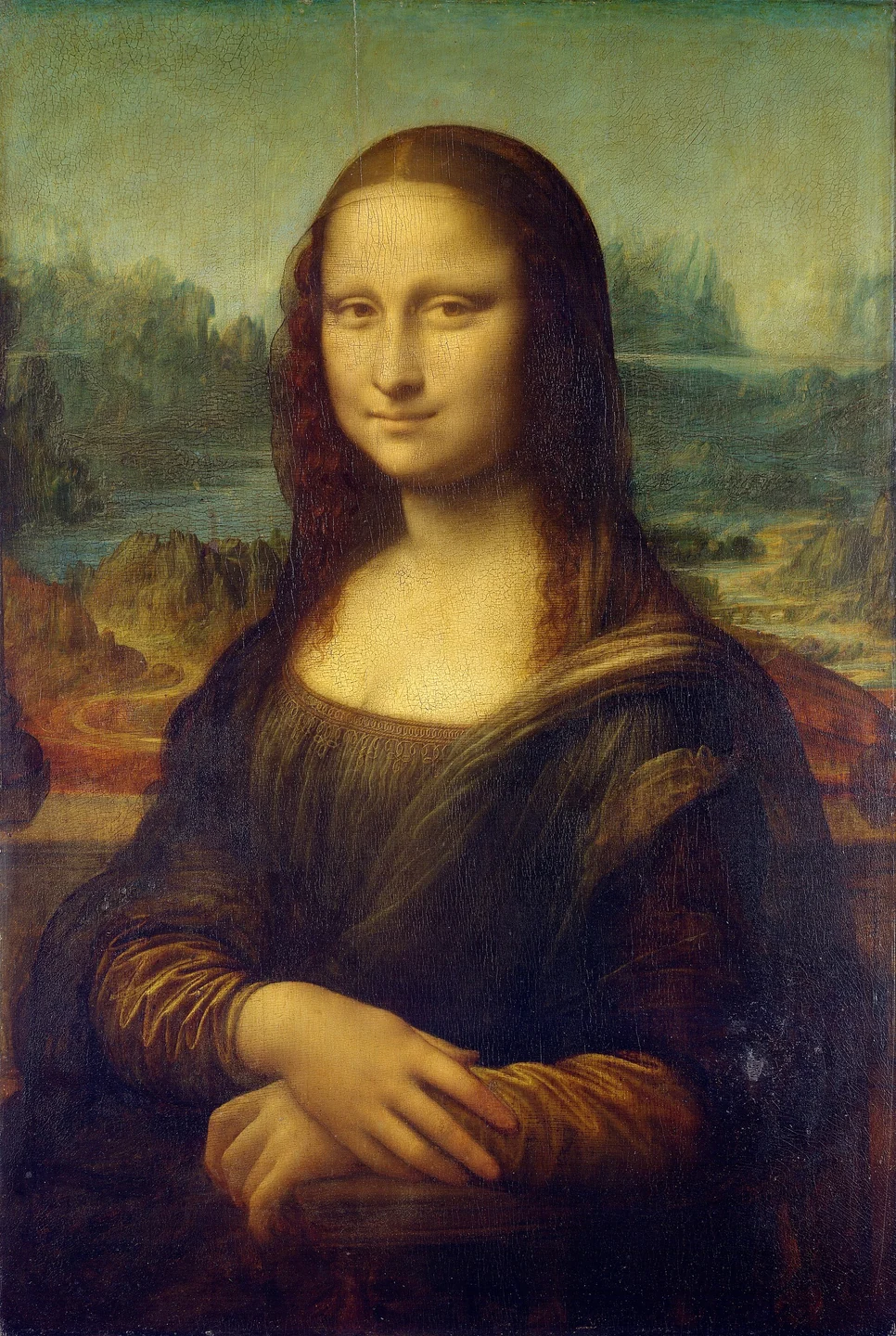
THE FULL STORY
A Face We Never Finish Looking At
There's a way of looking at the Mona Lisa that can wear you out: stare at the corners of her mouth and insist on figuring out exactly what she's smiling about. You stare, but she offers no explanation. Just when you think you've understood, your gaze shifts and you're not so sure. Take a breath. Leonardo hasn't left us a question we have to answer correctly. Try thinking of her as someone who has just turned toward you: you approach, she notices you, and the conversation has yet to begin.
In this story
01The portrait he kept by his side
She has a name: Lisa Gherardini, the wife of a Florentine silk merchant. Leonardo began painting her around 1503, when he was in his early fifties. The portrait stayed with him afterward, traveling with him from place to place until the end of his life.
That thought makes the painting feel suddenly tangible. This wasn't a job finished one afternoon and put aside once it was hung on a wall. A man slowly grew older, while a face remained on a wooden panel, there for him to keep thinking about. We don't know what he changed each time he picked up his brush, but that elusive play of light and shade around her mouth certainly deserves a little more of our time.
02A smile without a clear edge
Try drawing a smiling face on paper. Turn up the corners of the mouth, and anyone will understand. Leonardo, though, made the most easily explained part remarkably subtle. No hard line pins the smile in place; the shadows gradually blend into her cheeks. This soft transition is called sfumato: thin layers of paint and subtle shifts between light and shade soften the contours as if seen through smoke.
Here's a small experiment: look first at her mouth, then at her eyes, and finally relax your gaze to take in her whole face. Your sense of her expression may change along the way. You don't need a secret code to explain it. In everyday life, we don't read someone's emotions simply by measuring the angle of their mouth. Their eyes, the light, and our own mood all play a part.
03Her hands give our gaze a place to rest
Her face may be hard to read, but her hands rest quite steadily. One lies over the other, the fingers slightly curved, gripping nothing. They don't seem to announce her status or wait to be admired for their beauty. They simply rest there naturally.
Imagine replacing those hands with clenched fists, without changing a single brushstroke in her face. Wouldn't your impression of her change at once? That's one of the pleasures of a portrait: emotion can extend from the corners of a mouth all the way to the fingers. We spend so long staring at the smile that we often miss the parts speaking for the face. Her dark clothes separate her face from her hands, giving the eye a quiet pause as it travels downward.
04She sits close to us; the world behind her is far away
Look past either shoulder. A road curves, water stretches into the distance, and mountains recede, layer by layer, into grayish blue. There's no window or table here to tell us exactly what room she lives in. You can almost imagine sitting down opposite her, yet it's hard to enter the landscape behind her.
The hands nearby feel warm and solid; the distant mountains and water seem beyond reach. Bringing these two distances together gives the portrait a particular feeling: this person is right before us, yet her world extends far beyond what we can see. As for what lies behind those mountains, we can leave it there for now. Some parts of a painting leave room for our gaze precisely because they don't tell us everything.
05An absence that made headlines around the world
In 1911, the painting was stolen from the Louvre. It wasn't recovered until 1913. It was already highly admired, but the theft brought it to the attention of a much wider public. Today, many people know her name long before they see the original.
It's curious that a painting could draw more attention by being absent from its wall. When we look at her today, we bring some of the expectations that fame creates: surely a world-famous painting ought to amaze us at once? Yet her movements are so slight, and her colors take their time. To notice the subtleties, we may first need to quiet the applause in our heads.
06Stay with this meeting a little longer
Leonardo's contemporaries already took notice of this portrait, and the young Raphael drew inspiration from it. One small shift helps us understand its significance for later portraiture: the person inside the painting seems to respond to the person outside it. That draws us into the encounter, too.
Take one last look at her pose. Her body is turned slightly sideways and her face turns toward us, but her hands haven't joined in the movement. She seems to have her own sense of time, letting you come closer without rushing to explain everything. Today she might seem friendly; another day, distant. Either way, you can look again. Spending time with a good portrait can be rather like getting to know a person: what you see at first is often only the beginning.
References
- Louvre Collection Record: Portrait of Lisa Gherardini
The sitter's identity, the date of the painting, Leonardo's retention of the work, and its influence on Raphael.
- Louvre: From the Mona Lisa to The Wedding Feast at Cana
The sfumato technique and the painting's theft and recovery between 1911 and 1913. The remaining passages on looking at the painting are original observations.